


ChatGPT responses, quick commerce deliveries, and the time-saving assistance from Siri reflect the shifting lifestyles due to digital innovation!
But the real change is visible in the random replacement of repetitive jobs and thought-provoking words like AI-PRONE and AI-PROOF in the job market.
In this era of mass layoffs, parents and stakeholders are understanding the real importance of thinking skills to raise a generation that is ahead of machine intelligence.
And to prepare our children for this level of future success, we need to develop these higher-order thinking skills in children that make humans truly superior to machines.
One such skill is DIVERGENT THINKING, or the capacity to come up with multiple creative ideas.
Sounds like a perfect solution?
Right?
Stay glued, as we have all you need – the meaning, need, and strategies to develop divergent thinking in children.
Let’s begin.
What Is Divergent Thinking?
Divergent thinking is one of the core human cognitive processes that supports our ability to create/generate ideas. It helps us unleash the creative possibilities beyond the regular responses/answers to a problem.
Why Do Children Need Divergent Thinking?
Divergent thinking helps children view problems and solutions from different perspectives. With this ability, children look for innovative ways of thinking. Being divergent also boosts related skills like creativity and analytical thinking – The most sought-after skills for the future!
Puzzled about making this happen?
Read on.
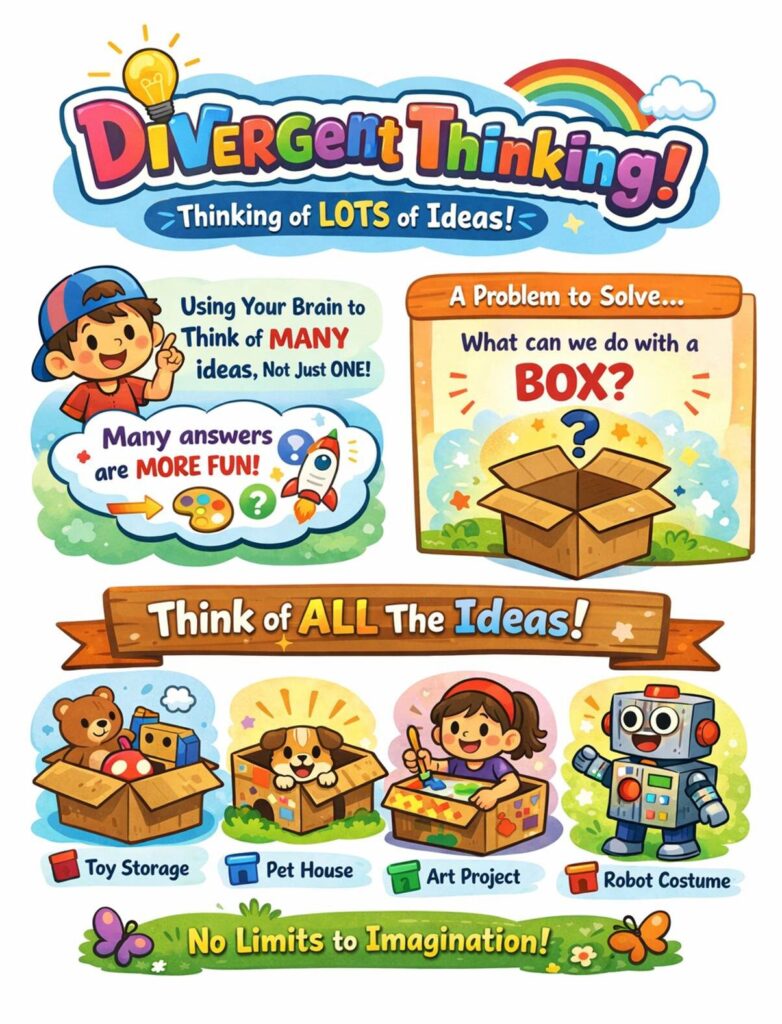
Strategies to Develop Divergent Thinking in Children?
Analytical Tasks
Start with these fun no-prep activities. Let children look at a picture or an object, and give them 5 minutes to write different meanings/uses. This activity can be planned in the classroom or at home. Make it fun with a touch of reinforcement. So, end this activity with a snack or some extra screen time to encourage the child.
Remember that divergent thinking is all about believing in multiple ideas and not sticking to a single thought. So, do not label a response as correct or incorrect to model divergent thinking in the real sense.
Joy + Play = Thinking
You already know that the nature of play is free and unstructured. And this freedom allows an uncontrolled flow of thoughts that makes way for divergent thinking.
Children unveil their creativity when they have the freedom to make choices. But if you confine them to limited thoughts/steps, their ability to look for creative solutions is hindered.
Hope you get the logic now – More fun, play, and freedom boost divergent thinking.
Use the SCAMPER Technique
Techniques like SCAMPER help build creative thinking skills. You can also try this one to enhance your child’s divergent thinking abilities.
Try it this way-
Select an essay and let the child (only middle and high school children) use his/her thinking abilities to:
- Substitute – Change parts, words, and style of expression.
- Combine – Link and combine similar ideas into a single one.
- Adapt – Look for patterns that can fit into this essay.
- Modify, Magnify, or Minify – Understand the parts that need to be cut short, highlighted, or elaborated.
- Put to Another Use – Derive a new context with the text.
- Eliminate – Remove unnecessary parts of the essay to improve readability.
- Reverse or Rearrange – Change the order to make it more engaging.

Try Divergent Thinking Exercises
(Ideas for Parents)
How Does it Work? – Activate the parts of the brain with open-ended questions. For instance, ask about the uses of empty plastic bottles with or without caps. Now reverse the question, and let them think about the uses of the caps without any bottles.
My Weird Story- All family members start a story-building competition by circulating a piece of paper, and they keep adding a sentence to it with a colored pen (choose different color pens for all family members). Encourage weird additions to this story. Now, once the story ends, one member reads it out, and all members applaud the most creative sentence. The winning member is identified based on the color of the pen used.
Drawing with Objects – Encourage the child to draw a shape/image and enhance it with an object of everyday use. For instance, a ribbon pasted to the ponytail of a girl’s picture; the mouth of a fish can be a clip or paste some real feathers to a unicorn.

Before we wrap up, here’s an alarming fact about regular educational models and their impact on a child’s creativity levels.
Some Findings About Education and Creativity
Regular educational practices kill creativity and promote mediocre thinking in children.
Yes.
Here’s an interesting finding to back this statement!
A study reveals that 98% of kindergarten children are at a genius level in divergent thinking. But by the age of 10 years, only 50% of children remain at this level.


This data indicates that formal education cages children’s minds to think in a certain way. And they start relying on ready-made responses to score well in their exams. Within this academic ladder, they keep losing their creativity at each step.
Final Thoughts
As the world continues to evolve at a rate that is faster than we can imagine, it is important to help our children regain their ability to think divergently.
Today, career ladders are completely different from bookish knowledge. And the future belongs to individuals with the capability to derive creative solutions beyond the regular ideas.
Bid goodbye to outdated educational models today, and choose the best online school to cultivate this skill in your child. Remember that meaningful education alone can build skills for the future. So, if you truly wish to witness the advantage of visionary education, an accredited online school is your best pick.
THE CHANGE BEGINS WITH YOU.
CHOOSE AN ONLINE SCHOOL TODAY and nurture the divergent-thinking superpower to prepare your child for a landscape of possibilities!
Thanks for Reading!
Frequently Asked Questions
How can we build divergent thinking in children?
You can engage children in divergent thinking activities, encourage out-of-the-box ideas, and use techniques like SCAMPER to unleash their creative side.
Suggested Read
- Rediscovering Joy: The Benefits of Reading Books in the Digital Age
- 100 + Fruits Names in English for Kids
- Proven Ways to Make Kids Smarter: 10 Science-Backed Tips
- Unchecking Societal Boxes: Ways to Promote Gender Equality at Home
- Developing Confidence: Effective Ways to Help a Child Overcome Fear of Public Speaking
- Profound Benefits of Drawing in Education and Tips to Develop this Skill in Students
- 100+ Vegetables Names in English for Kids: Benefits, Types, and Facts
- Online Schooling in India Explained: Is It Right for Your Child?
- Student Habits That Can Transform a Student’s Life
- Empowering Students: 10 Basic Computer Skills to Master in 2026
- How to Increase Memory Power: 10 Practical Tips for Students
- Personal Grooming for Students: Benefits, Ways to Teach, Tips and More
- How to Become Topper: 10 Easy Yet Practical Strategies
- Gaming In Education: A Useful Tool In The 21st Century?
- Handling Big Teen Emotions: Strategies and Helpful Tips
