


Looking for tips to teach coding at home?
Well!
You’ve already won half the battle by realizing the importance of coding in this rapidly evolving digitalized world.
Leave the rest to us, and get ready to learn about the best ways to teach your child coding at home.
But before we start, here’s a look at the benefits of coding for students
What are the Benefits of Teaching Coding to Children?
Skill Building
Coding has great prospects in the present-day world. It enhances thinking skills and supports brain development at the most crucial stages. Learning to code also helps children develop the skill of breaking down complex information to delve deeper into it.
Makes Children Resilient
Trying again and again, failing, not giving up, and coping with hardships is a sign of resilience. Coding makes a child resilient and instils a love for learning without fearing mistakes.
Future Readiness
The future is all about thinking skills and innovation. And coding develops a child’s ability to reason and explain sequences/steps logically.
It’s astonishing that coding can improve your child’s IQ by 1000% or his/her critical thinking by 20x!
Yes!
If taught well, you can witness advanced problem-solving abilities in your child over a period of time.


After these benefits, let’s get ready to know all about teaching coding at home.
Read on.
7 Tips for Introducing Your Child to Coding at Home
1. Get the Basics Right
Just like any beginner, it is better to go step-wise.
- Start explaining simple details to the child, like:
What is coding?
Humans connect and interact with each other with the help of languages. Similarly, coding is a language that helps humans interact with a computer. In other words, coding is a language that a computer can understand. Once done correctly, it helps in making the computer function in the right way as per the given command. And eventually, the computer completes the task perfectly.
How does coding work?
For humans, any task requires a step-wise process with instructions/patterns. Similarly, coding is a flow of commands for a computer to perform a task successfully.
Do not forget to share some real-life examples to set the tone right. You can use examples like taking notes in class in a sequence, the levels of a video game, or following the steps of a cooking recipe to make it clearer.
Now move on to explaining the related terms, such as the meaning of programming language, command, data, structure, algorithm, etc. It will make the child familiar with these terms, and he/she will be able to relate to these during the process.
2. Use Relevant Tools
Online tutorials and applications can be excellent sources to teach coding to a child.
Start with the basics and build fundamental knowledge of coding.
Help your child create games, interactive stories, and animations with ‘Scratch’ (programming language and online community). You can follow the tutorial and explain these simple tools to support your child. These drag-and-drop opportunities will help your child build a logical understanding of coding, sequencing, and concepts that are abstract in nature.
You can also find some free online classes and other online resources to introduce coding to your child. Once the child masters one language and uses the platform well, move on to another level.
3. Let the Child Take the Lead
Explaining, helping, supporting, and yet taking a back seat is the best way to help your child understand complex concepts. Allow the child to break down problems into manageable chunks, and encourage him/her to find solutions to make things better. Coding is all about supporting brain development. So, avoid overindulging in any way, and let the child discover, fail, and succeed while learning to code.
4. Set Your Schedules
To teach your child coding, you need to be consistent with dedicated schedules and have some dedicated practice time. Set a weekly timetable with at least 5 days a week for coding practice. And make sure you have ample time to help the child rework mistakes and learn from them.

5. Make it Collaborative
Teaching coding need not be an individual activity for your child. You can always involve other children, have family members around, and look for more participants through your online communities. Make the process interesting with fun challenges, snack breaks, music, and some reinforcement strategies.
6. Create a Holistic Experience
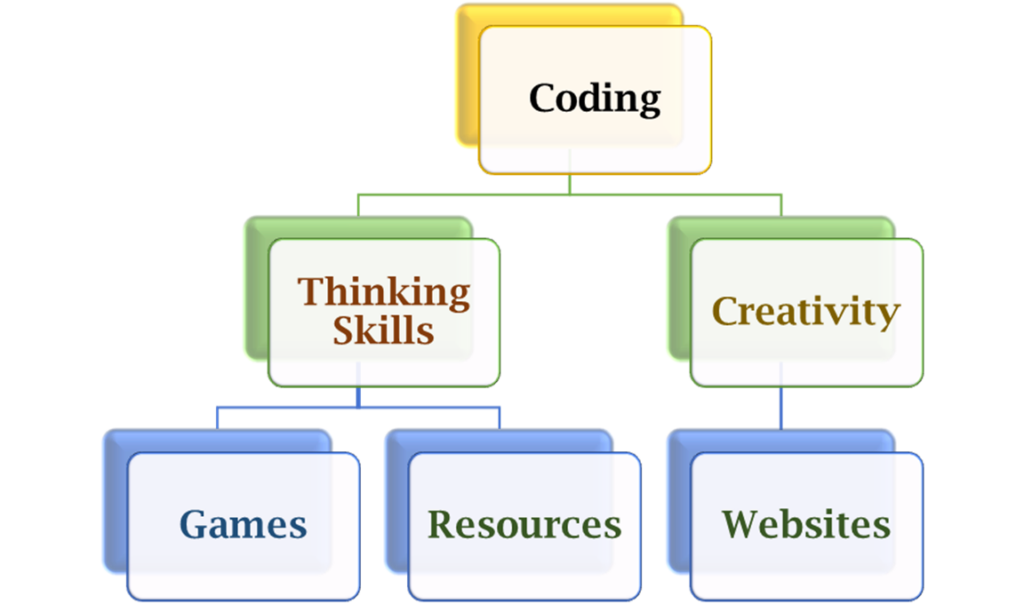
Teaching your child to code is beyond online resources. Family discussions, book reading, solving puzzles, and learning key skills also help your child build relevant skills that support this process.
Think of it like this-
A cooking recipe requires sequential execution of the steps and organizational skills. Similarly, strategizing for a game and learning new languages are great ways to understand the components/constructs of a process.
7. Mix Resources
Varied mobile applications, websites, programming games, and virtual resources offer different levels of experiences. Try to mix things up and create a wholesome learning experience for the child.
It’s time for some tips now.
Quick Tips
- You can make use of websites like Coursera, edX, SoloLearn, Khan Academy, and Udemy to teach coding.
- If you find it difficult to teach coding to your child at home, look for online programs with a mentor to make things easier.
- Always stay away from the practice of sharing too many ready-made solutions to problems. Instead, let the child look for solutions to boost thinking skills.
- Most children find the drag-and-drop block system easier to pick up the basics of coding.
- Learning programming languages supports coding skills in children, so start with programming languages at an early stage (as the child reaches 11 or 12 years of age).
Final Thoughts
Coding helps children develop relevant skills like critical thinking, creativity, and problem-solving. They learn about identifying problems and dealing with them with logical and sequential solutions.
Fortunately, India is doing well in nurturing young coders, and states like Kerala are trend-setters with almost 9.8% of its population (between 15 and 29 years) capable of coding.
Take a look at some of the best Indian states with the percentage of people capable of coding:
| State | % |
| Kerala | 9.80% |
| Sikkim | 6.80% |
| Tamil Nadu | 6.30% |
| Karnataka | 6.20% |
| Telangana | 5.70% |
| Andhra Pradesh | 4.20% |
| India’s National Average | 2.40% |

It’s time to nurture more young coders and help them LEVEL UP their coding skills for a brighter future!
Visionary educational institutions like K8 School are already playing their role in making children future-ready!
You can also connect with us to learn more about 21st-century skill-building in young learners!
Thanks for Reading!
Frequently Asked Questions
- Can parents teach children coding at home?
Yes, you can find some great websites and online resources to help your child learn coding at home. - Does coding make children good problem-solvers?
Yes, coding builds essential skills in children, such as critical thinking, problem-solving, perseverance, organizational skills, etc.
Suggested Read
- ICT in Education: How is it Transforming Teaching and Learning Process
- Empowering Students: 10 Basic Computer Skills to Master in 2026
- Blended Learning- A Technology-Backed Solution to Deliver Student-Focused Instructions
- How to Increase Memory Power: 10 Practical Tips for Students
- Personal Grooming for Students: Benefits, Ways to Teach, Tips and More
- How to Become Topper: 10 Easy Yet Practical Strategies
- Practical Strategies and Effective Steps to Overcome Laziness
- 10 Captivating Games for English Learners
- Profound Benefits of Drawing in Education and Tips to Develop this Skill in Students
- Gaming In Education: A Useful Tool In The 21st Century?
- 10 Life Skills for Students: Building Leaders of Tomorrow
- Educational Robotics: A Stride Forward In Online Education
- Exam Motivation: Ace Your Exams And Achieve Your Academic Goals!
- Time Management Tips For Students
